Towards Software-Defined Soft Robotic Antennas for Spectrum Era 4
This webpage tracks the current progress of our NSF-funded project. Our sincere thanks to the National Science Foundation for supporting our research.
Project Goals
This project aims to design Softenna, a first-of-its-kind soft-robotic, highly reconfigurable antenna platform that dynamically adapts its RF properties—including center frequency, beam pattern, directionality, and polarization—through a combination of mechanical and electronic reconfiguration.
Softenna combines innovation in wireless systems and soft robotics, enabling curriculum development at the university and K–12 levels. It is composed of multiple elements fabricated using stretchable and flexible materials and liquid metal, offering rich shape changes and a learning-based pipeline that identifies which shape pattern is best suited to a given operating frequency, device location, and environment.
The system will be fully implemented on soft robotic antennas integrated with software-defined radios operating in the sub-6 GHz frequency bands. Key contributions include:
Design of Softenna platforms enabling rich variations in operating frequency.
Accompanying algorithms supporting learning and programming of platform behavior to best suit any given environment.
Comprehensive implementation and evaluation through varied testbeds, both indoors and outdoors.
As part of educational and outreach efforts, investigators will develop a workshop module where high-school students program wireless radios via CMU’s Spark Saturday program and integrate findings into university-level courses in wireless systems and robotics.
Activities & Outcomes
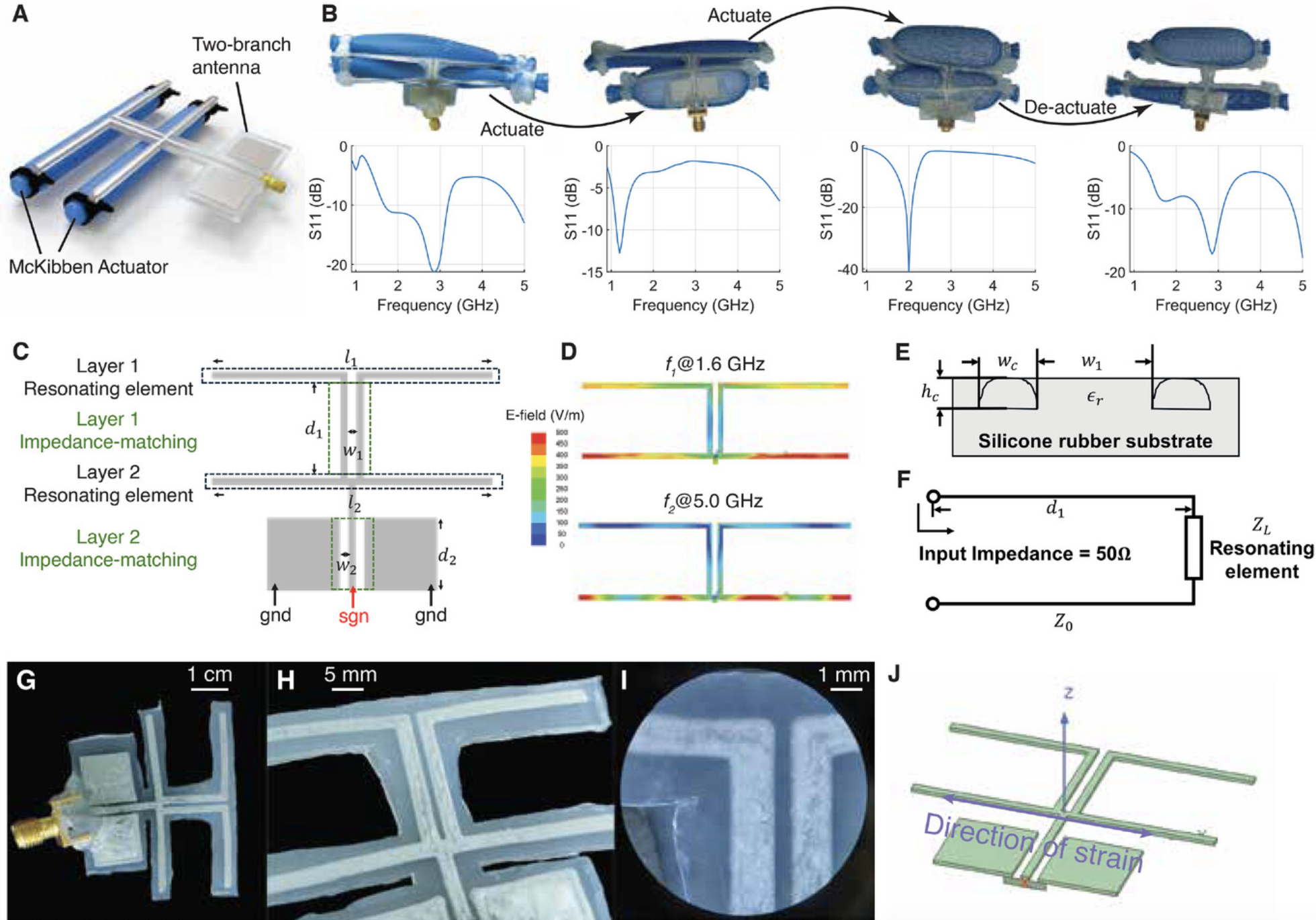
Intellectual MeritPASTA: stretchable liquid-metal branches actuated to reconfigure across 1–5 GHz.
The proposed research led to an accepted paper at Advanced Science. The research has been demonstrated on flexible antenna platforms.
Pneumatically-Actuated Liquid Metal-Based Frequency Reconfigurable Antenna, Yiwen Song, Aditya Bharambe, Dinesh K Patel, Barbara Zhuo, Mason Zadan, Carmel Majidi and Swarun Kumar, Advanced Science 2026
Broader Impacts
One graduate student has been trained during the course of this research. The PI participated in several events organized by the Gelfand Center at CMU which invites groups of K–12 students and teachers to the CMU campus to learn about state-of-the-art research.